


Tennis Clash: Multiplayer Game
Wildlife Studios
I approached Tennis Clash: Multiplayer Game expecting a quick sports title for short breaks, and that is still where it makes the most sense to me. It turns a tennis rally into a compact online contest, so I can play a match without committing to a long career session or learning a full console-style control scheme. The appeal is immediate: movement, timing, positioning, and shot selection matter more than memorizing a large set of buttons.
After spending time with it, my view is positive but not uncritical. This is a polished online tennis game with a very large audience, yet its strongest quality is also its main limitation: it is designed around fast, repeatable matches. If you want a deep simulation with every tactical option represented, you may find it simplified. If you want a sports game that is easy to start and difficult to master, it is much easier to recommend.
How the matches feel in everyday play
The basic rhythm is refreshingly clear. I enter an arena, wait for an opponent, and focus on returning the ball while trying to create an opening. The controls are built for touchscreens rather than physical buttons, which makes the first few games approachable. I do not need to remember a complicated command layout; I need to read the incoming ball and react with enough precision.
That simplicity should not be confused with a lack of decisions. A safe return may keep a rally alive, while a more aggressive shot can put pressure on the other player but leave less room for error. Positioning also changes the character of a point. Standing in a comfortable place is not always enough, especially when the opponent starts directing the ball away from where I am ready to move.
The short-match format fits real life unusually well. I can play a contest while waiting for a train, during a lunch break, or when I only have a few minutes before doing something else. The danger is that “one more match” is easy to justify because each individual game feels manageable. For players who prefer a relaxed, occasional experience, that loop can be convenient. For anyone sensitive to competitive repetition, it can become a little demanding.
Related News

Why WhatsApp Messenger Still Makes Everyday Communication Feel Easy

Jurassic World: The Game Is the Better Dino Tycoon for Strategic Players

Threads in Real Life: Who Should Join, Lurk, or Leave

How SHEIN Turned Shopping Into an Endless Content Feed

How to Make Fortnite Feel Smarter on Mobile

Should You Switch to Microsoft Outlook on Mobile?
Wildlife Studios has positioned the game as a live PvP sports experience rather than a solitary tennis toy. That distinction matters. The satisfaction comes from responding to another person, not simply from beating a predictable computer opponent. It also means the quality of a session depends on how much I want to compete at that moment. When I am focused, the matches feel tense and rewarding; when I am tired, small mistakes can feel more frustrating than they should.
Learning the touch controls without rushing
My best early advice is to resist the temptation to hit every ball as hard as possible. A new player can easily mistake speed for quality, but a controlled response is often more useful while learning the timing. I found it better to watch the opponent’s preparation and think about where the return should go instead of dragging rapidly out of panic.
Another useful habit is to treat the first part of a match as information gathering. I pay attention to whether the other player prefers the same side repeatedly, whether they take risks near the lines, and whether they react slowly when forced to change direction. This makes each point more interesting than simply swiping toward the nearest empty space.
Gallery
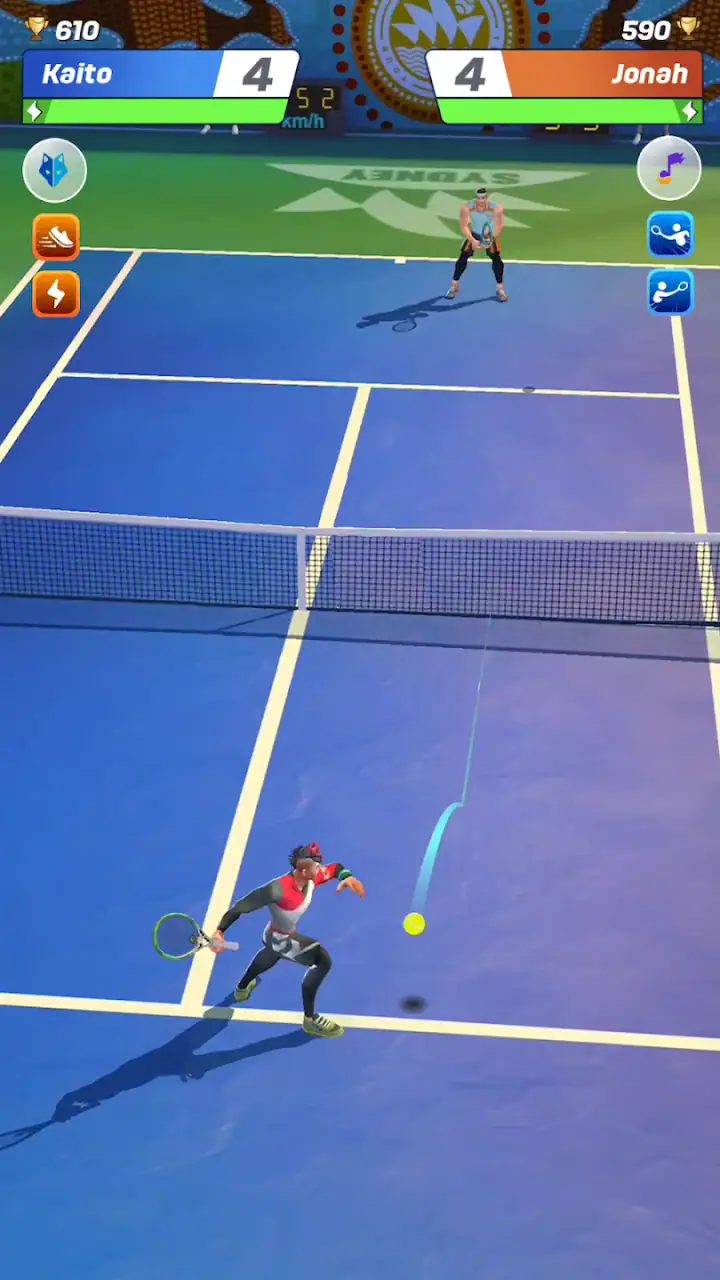
The game is especially friendly to people who have not played a traditional tennis simulator. Its presentation communicates the action quickly, and the controls do not bury the important decision under menus or technical input. However, players who enjoy manual control over every serve, footstep, and stroke may see that accessibility as a compromise rather than a strength.
Progression creates a second game around the matches
Playing is only part of the experience. Like many competitive mobile sports games, this one gives progress a larger role than a single rally. I am not just asking whether I won the point; I am also thinking about whether the result helps me move forward and become more competitive in later arenas. That structure gives regular players a reason to return, but it can also make losses feel connected to longer-term progress.
The pressure becomes noticeable when I start treating every match as a test of my account rather than a self-contained game. A defeat is easier to accept when I am experimenting with timing or learning an opponent’s habits. It is harder when I feel that I have spent time preparing and now need a victory to maintain momentum. This is where the title shifts from casual entertainment toward a more persistent competitive routine.
My practical approach is to separate learning sessions from progress sessions. When I am trying a different style, I focus on observing the ball and improving decisions instead of judging the result. When I want to compete seriously, I play only when I am alert. That small distinction reduces the urge to chase a bad result with another rushed match.
Players should also decide early how much progression matters to them. Someone who is happy to enjoy individual matches can treat the surrounding advancement as background. Someone who wants to climb consistently will need more patience, because improvement depends on repeated practice rather than a single clever trick. The game rewards attention to patterns, but it does not remove the emotional swings that come with online competition.
Spending deserves a careful, realistic look
The game is free to download and play, while optional purchases range from $0.49 to $149.99 per item. That is the important purchase context for anyone deciding whether to try it. I can begin without paying, but the presence of a wide purchase range means spending can become part of the surrounding experience for players who want to accelerate or support their progress.
I would not describe the purchase system as a reason to avoid the game automatically, but I would recommend setting a personal limit before getting invested. The most vulnerable moment is usually after a frustrating loss or a period of slow progress. Buying something in that mood can feel like solving the immediate problem, even when the real issue is timing, decision-making, or simply facing a stronger opponent.
My rule is simple: decide what the matches are worth to you before the progression starts asking for more attention. If the free experience already provides enough entertainment, there is no need to turn every setback into a purchase decision. If you choose to spend, it is better to see that as paying for continued enjoyment rather than as a guarantee of better play.
The listed purchase range tells me the game has room for both small and very large transactions, but it does not by itself answer every fairness question. I do not want to claim that spending always determines a result, nor do I want to pretend that purchases are irrelevant. The sensible conclusion is narrower: players should approach the competitive progression with a budget and should not assume that paying removes the need to learn the game.
Is the competition fair enough to stay enjoyable?
Fairness is the question I would ask before recommending any live PvP game. In this case, I judge fairness less by whether every match feels perfectly equal and more by whether I can understand why I won or lost. When a point is decided by poor positioning, late reactions, or an overly ambitious shot, the result feels useful. When I am unsure whether the opponent’s advantage came from skill, progression, or something else, the experience becomes less satisfying.
The compact format makes this especially important. In a long sports match, a bad moment can be recovered through several games. In a short contest, one or two mistakes can shape the entire result. That creates excitement, but it also magnifies any imbalance. I recommend giving the game enough time to show its patterns before deciding that a difficult opponent is automatically unfair.
My strongest competitive tip is to review the decision immediately after a lost point. Did I move too early? Did I aim for an ambitious return when a safer shot would have kept the rally alive? Did I allow the opponent to dictate the direction? This kind of self-review is more valuable than blaming the result, and it helps reveal whether the game is teaching me something or merely making me repeat the same mistake.
There is also a psychological fairness issue. A player can technically have a fair chance and still feel pressured by the progression loop, the desire to maintain momentum, or the temptation to spend after a loss. That is not a claim about hidden systems; it is a reason to manage expectations. I enjoy the game more when I treat each match as a small competitive activity, not as a judgment on my overall ability.
Where it beats traditional alternatives
Compared with a full tennis simulation on a console or computer, this is much easier to pick up for a quick session. I do not need a large screen, a controller, or a long uninterrupted block of time. The touch-first design makes it more approachable, and the online structure gives the matches a human unpredictability that a fixed single-player mode may not provide.
Compared with a purely arcade tennis game, it asks me to pay more attention to placement and timing. The opponent is not just an obstacle moving along a preset pattern, so I have to adapt. That makes a close victory feel more personal and more rewarding than simply reaching a score target.
Those advantages come with clear trade-offs. A console-style title is usually better for players who want detailed control, longer matches, and a broader simulation of the sport. A simple offline arcade game is better when I want instant entertainment without matchmaking pressure or progression concerns. This game sits between those choices: more competitive and persistent than a throwaway arcade experience, but more streamlined than a serious simulation.
I would also skip it if online competition itself is the problem. The game’s identity depends on live multiplayer arenas, so someone looking for a calm offline tennis experience is choosing the wrong type of product. Likewise, players who dislike touch controls may never feel fully comfortable, even if they understand the strategy.
What I would like to know before committing
A common concern is whether the game is suitable for younger players. It carries an Everyone content rating, which makes it broadly accessible from an age-classification perspective. That does not remove the need for sensible supervision around online play or spending, but the rating makes it easier to consider for a general family device than a title built around mature themes.
Another practical question is whether an older phone can run it. The listed minimum operating system is Android 7.0, so the software requirement is not aimed only at the newest Android devices. Actual comfort will still depend on the phone’s performance and connection, especially because this is an online game where responsiveness matters more than it would in an offline puzzle.
People also ask whether the game is still actively maintained. The current version is 6.26.1, which shows that the app has continued receiving version updates beyond its original release on October 23, 2019. I would still judge each update by how the game feels on my own device, but the version history context makes it more reasonable to expect an evolving live product rather than a one-time release.
The audience size is another clue, though not a guarantee of a perfect experience. The game has passed 100 million installs, holds a 4.6 average from around 2.2 million ratings, and has roughly 33 thousand written reviews. Those figures suggest strong mainstream interest, but they should not replace personal judgment. A popular competitive game can still be a poor fit for someone who dislikes short, high-pressure matches or optional purchases.
Small habits that improve the experience
First, I recommend playing with a stable connection and avoiding serious matches while multitasking. A touch response that feels late can turn a manageable rally into a frustrating one, and it is difficult to tell whether the problem was my timing or the connection when I am distracted.
Second, I try not to change several things at once. If I alter my approach, my shot choices, and my movement habits after one loss, I learn nothing from the result. Changing one habit at a time makes improvement easier to notice. For example, I might spend a session prioritizing safer returns, then another session working on directional pressure.
Third, I use close losses as a better learning resource than easy wins. A comfortable victory can hide weak habits because the opponent never exposes them. A narrow defeat often shows exactly where my decision-making breaks down. That is one of the less obvious strengths of a compact PvP format: feedback arrives quickly if I am willing to examine it.
Finally, I stop when I notice that I am playing to recover pride rather than to enjoy tennis. This is particularly important in a progression-based mobile game. The next match may be short, but the emotional cost of chasing a result can be much larger than the time spent playing it.
My trust verdict after playing
I see Tennis Clash as a convincing choice for players who want accessible online tennis with enough tactical depth to reward practice. Wildlife Studios has made the central action easy to understand while leaving room for better timing, smarter placement, and more disciplined decisions. The large player base and strong average rating support the idea that the format works for many people, though neither measure guarantees that it will suit every temperament.
My recommendation comes with boundaries. I would install it for quick competitive sessions, especially if I enjoyed learning an opponent’s habits and improving through repetition. I would not choose it as a replacement for a detailed tennis simulator, an offline sports game, or a completely pressure-free pastime. The free entry is helpful, but the purchase range means I would make a spending plan before progression becomes emotionally important.
The most trustworthy way to approach it is to keep the priorities in the right order: enjoy the rally first, learn from the result second, and treat purchases as optional entertainment spending rather than a shortcut to certainty. With that mindset, the game’s strengths stand out clearly. Without it, the competitive loop may feel more demanding than its friendly presentation suggests.
For me, the final decision is a qualified yes. It is free, rated for Everyone, and available on Android devices meeting version 7.0 or later, so the barrier to trying it is modest. I would give it a fair chance if I wanted a sports game that fits into everyday gaps, but I would keep expectations realistic: the fun comes from improving inside a fast online contest, not from receiving a complete tennis simulation or a guarantee that every match will feel equal.
FAQs for Tennis Clash: Multiplayer Game
What is Tennis Clash: Multiplayer Game?
Tennis Clash: Multiplayer Game is a real-time sports game where players can compete against others from around the world in thrilling tennis matches. It offers intuitive controls, stunning graphics, and a variety of characters and equipment to enhance the gameplay experience, making it appealing for both casual and competitive players.
Is Tennis Clash free to play?
Yes, Tennis Clash is free to download and play on both Android and iOS platforms. However, it includes in-app purchases for players who wish to enhance their experience by acquiring special items, characters, or upgrades. These purchases are optional and not required to enjoy the game fully.
What devices are compatible with Tennis Clash?
Tennis Clash is compatible with most modern smartphones and tablets running on Android and iOS. It requires Android version 5.0 or higher and iOS 10.0 or later. For optimal performance, ensure your device meets these requirements and has sufficient storage and memory available.
Does Tennis Clash require an internet connection?
Yes, Tennis Clash requires a stable internet connection to play. As a multiplayer game, it relies on real-time interactions with other players. A good Wi-Fi connection or a reliable mobile data plan is recommended to ensure smooth gameplay without interruptions.
How can I improve my skills in Tennis Clash?
To improve your skills in Tennis Clash, practice regularly and experiment with different strategies. Utilize the training modes, upgrade your equipment, and choose characters that match your play style. Engaging in matches against a variety of opponents will also help you learn and adapt to different tactics.
Pros
- Realistic graphics enhance gameplay experience.
- Quick matches fit into busy schedules.
- Wide range of characters and gear.
- Frequent updates keep content fresh.
- Engaging multiplayer tournaments.
Cons
- In-app purchases can be expensive.
- Requires stable internet connection.
- Limited offline play options.
- Matchmaking can be unbalanced.
- Energy system restricts playtime.


